

What FP&A actually does: a map of the job, department by department
At a family dinner years ago, someone asked me what I actually do for a living. I said “FP&A” and watched their eyes glaze over. Then I tried “financial planning and analysis.” Worse. Finally I said: “when any department in the company wants to spend money, grow, or fix something, I’m the finance person who sits with them and works out whether it makes sense.” That landed.
Because that’s the real job. Not the budget spreadsheet. Not the monthly pack. The job is being finance’s ambassador to every corner of the business, and each corner needs something different from you. I made a guide about exactly this, and it’s built around one map:
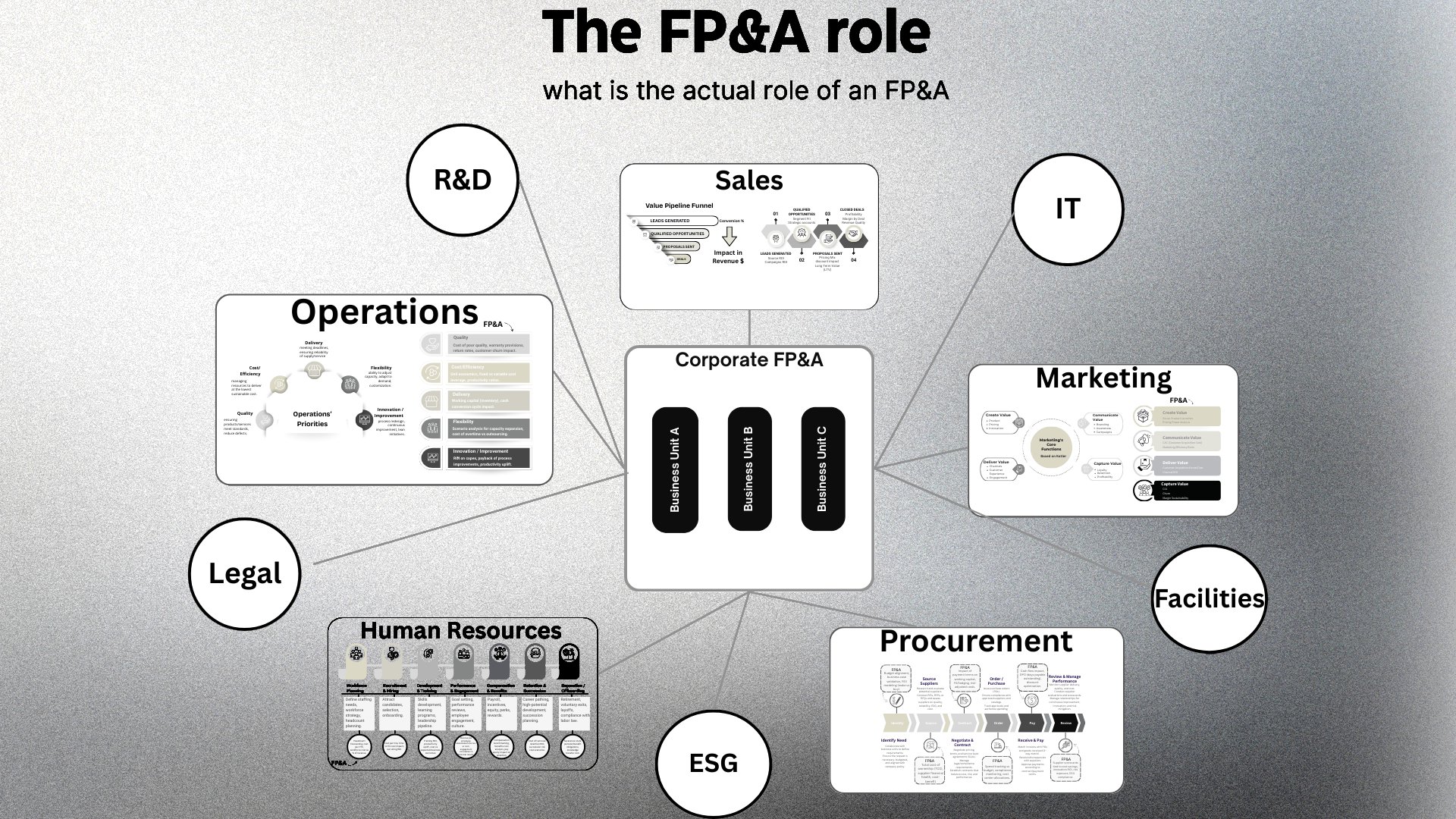
Corporate FP&A sits in the middle, holding the business units together. The spokes are where the interesting work happens. Let me walk you through a few of them, because “business partnering” stays a buzzword until you can say what it means with Sales versus what it means with HR.
With Sales: own the funnel math
The sales team lives in the pipeline. Your job is to connect that pipeline to revenue: leads generated, conversion to qualified opportunities, proposals sent, deals closed, and what each stage is worth. When FP&A owns that value funnel, two things change. Forecast conversations become arithmetic instead of arm wrestling. And when leadership asks “what happens to revenue if conversion improves one point,” you have the answer in the model, not in a promise.
With Operations: speak their priorities
Operations doesn’t think in P&L lines. They think in quality, cost, delivery, flexibility, and improvement. The FP&A contribution is translating each one into money both directions: the cost of poor quality (warranty provisions, return rates, churn), the working capital sitting in delivery and inventory, the scenario analysis for a capacity expansion, the payback on a process improvement. Partner well here and you stop being the person who cuts their budget and become the person who helps them win the investment case.
With Marketing: value both ways
Marketing creates, communicates, delivers, and captures value. Finance shows up at the capture step, usually to ask uncomfortable questions about ROI. The better version is showing up across all four: pricing input when value is created, campaign economics when it’s communicated, CAC and LTV when it’s captured. Marketing has plenty of creativity. What they often need from you is a defensible link from spend to revenue, one they can take to the CEO themselves.
With HR and Procurement: the quiet giants
People cost is usually the biggest line in the company, and the HR lifecycle (planning, recruiting, development, compensation, retention, exits) is full of decisions with long financial tails. Headcount planning done with FP&A is a workforce strategy. Done without, it’s a spreadsheet surprise in Q3.
Procurement runs the source-to-pay chain, and every step of it touches cash: supplier selection, contract terms, order discipline, payment timing. FP&A brings the bridge from negotiated savings to what actually lands in the P&L. If you’ve read my procurement article, you know how much gets lost between those two numbers.
The pattern across every spoke
Notice what repeats. In every department, the FP&A contribution is the same three moves: learn how they create value in their own language, translate it into financial consequences, and bring the numbers early enough to shape the decision instead of just scoring it afterward.
That’s also why I keep saying business acumen is the foundation of this job. You can’t partner with Operations if you don’t understand an operation. The modeling skill is table stakes. The differentiator is knowing what the model should say about someone else’s world.
Where to start if this is new for you
Pick one department. Just one. Ask their leader for thirty minutes and one question: “what decisions are you trying to make this quarter?” Then build the smallest useful thing, a one-page view that helps that decision. Deliver it, refine it, and let the word spread. Every strong business partnering function I’ve seen started with one spoke done well, not with a mandate.
The full guide
The download is the complete Role of FP&A guide behind the map above: every department spelled out, what partnering looks like in each, and the questions to bring to your first conversation. If you’re building a business partnering muscle, or explaining to your own family what you actually do, start here.
Get the full Role of FP&A guide
The complete guide behind the map: every department, what partnering looks like in each, and the questions to bring to your first conversation.