

Procurement has six steps. Finance belongs in every one of them.
Procurement people think finance only shows up twice: to approve the budget and to complain about it afterwards. I understand why. That’s genuinely how many finance teams operate around spend.
But procurement runs a six-step chain, and there’s finance work hiding in every single link of it. That’s the point of my Procurement FP&A guide, and it fits on one picture:
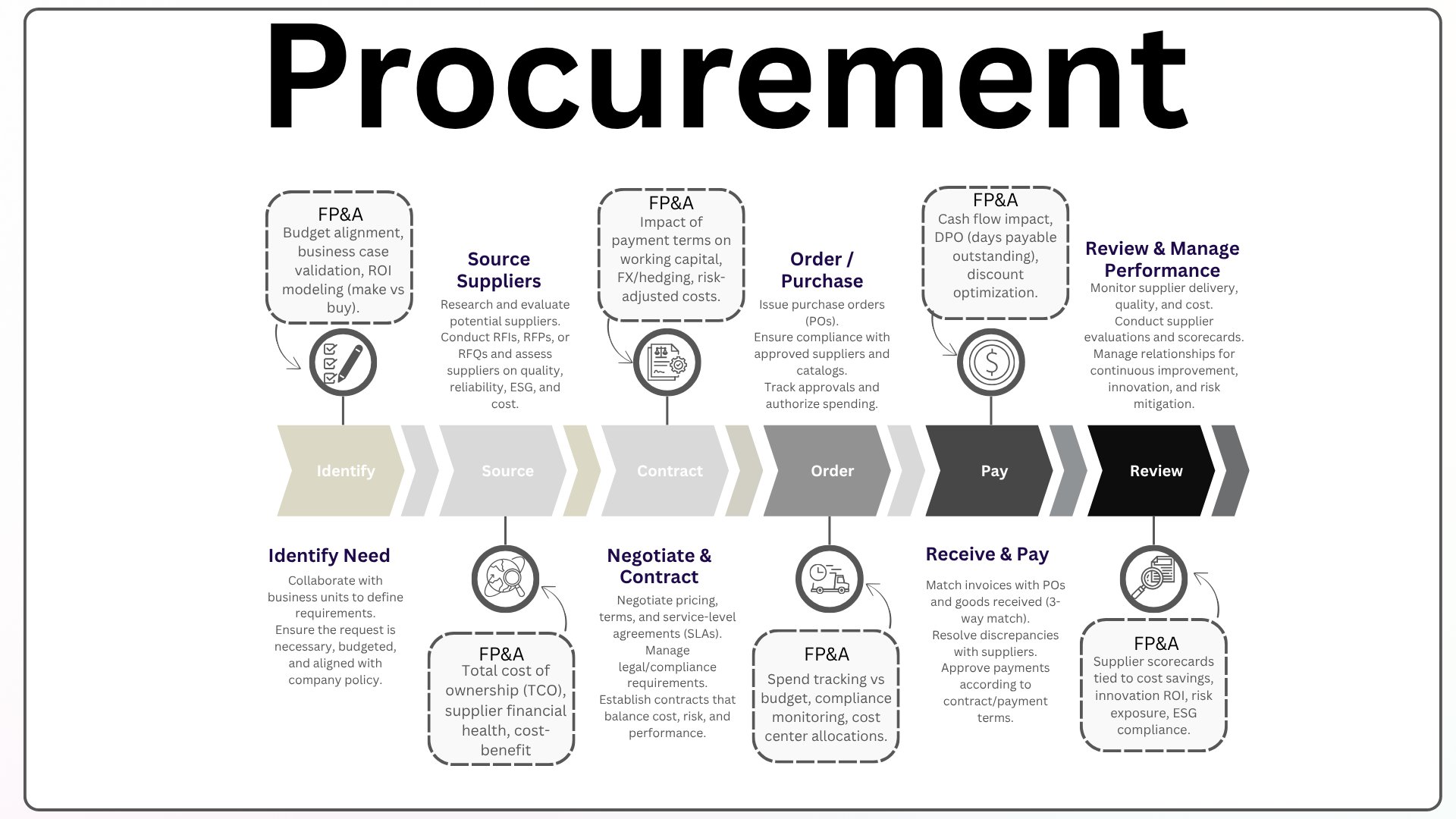
Walk it with me, because each step changes what “finance business partner” means in practice.
Identify: before anyone shops
The cheapest moment to influence spend is before it exists. When a business unit defines a need, FP&A brings budget alignment, business case validation, and the make-versus-buy ROI model. Ask the annoying question here (“do we need to buy this at all?”) and you save more than any negotiation will later. Skip this step and you’re just processing decisions someone else already made.
Source: the real cost of a supplier
Procurement compares quotes. Finance should be comparing total cost of ownership: price plus implementation, maintenance, switching costs, and risk. And one more thing people forget until it hurts: supplier financial health. A bargain from a supplier that goes under mid-contract is the most expensive deal you’ll ever sign. Pulling a credit view on strategic suppliers takes an hour and has saved companies I’ve worked with from very bad quarters.
Contract: where working capital gets decided
Payment terms look like a legal detail. They’re a financing decision. Sixty days versus thirty days on a large contract moves real money on the balance sheet, and FX exposure and risk-adjusted costs get locked in here too. This is the step where finance most needs a seat at the table and most often doesn’t have one. If you only insert yourself into one step of the chain, make it this one.
Order: keep the spending honest
Once contracts exist, the question becomes whether people actually buy through them. Spend tracking against budget, compliance monitoring, cost center allocations. Unglamorous, yes. But off-contract buying is where negotiated savings quietly evaporate, and the only way to see it is to measure it.
Pay: cash timing is strategy
The payment step holds a lever most companies never pull deliberately: DPO. Paying according to the terms you negotiated (not earlier out of habit) is free working capital. And when a supplier offers an early payment discount, someone should check whether the annualized return beats your cost of cash. Sometimes it’s the best investment available that week. Sometimes it’s a donation. The math takes thirty seconds and most AP departments never do it.
Review: close the loop
The last step is where the whole chain gets better or doesn’t. Supplier scorecards tied to actual cost savings, innovation ROI, risk exposure, ESG compliance. Finance’s job is keeping those scorecards honest: savings that trace to the P&L, not savings that exist only in a procurement dashboard. Most companies “save” more than their costs ever fall, year after year. The review step is where you catch that gap while it’s still fixable.
Watch the whole chain in action
I walked this exact cycle on camera, with the war stories attached: the hardware order we deferred by six weeks because finance saw prices were due to drop, which saved over 400,000 on timing alone. The supplier quote pegged to a currency we had exposure to, caught before the contract was signed. The tiered pricing clause we modeled in advance, so nobody ordered their way into a higher unit cost.
There’s also a hands-on piece in the middle I care about: a price-volume-mix breakdown of purchase orders against forecast, built step by step in Excel. Because a higher PO total doesn’t always mean prices went up. Sometimes the mix changed, or a contract tier wasn’t met, and the PVM split shows you which it was before the fingerpointing starts.
Start with one link
If your finance team touches procurement only at budget time, don’t try to colonize all six steps at once. Pick the contract step, offer to model payment terms on the next big renewal, and show the working capital impact in euros or dollars. One good analysis there buys you an invitation to the rest of the chain.
The guide
The download is the full Procurement FP&A guide behind the diagram: all six steps, the FP&A playbook for each, and the questions that make you useful in the room instead of a checkpoint at the end. Grab it below.
Get the Procurement FP&A guide
All six steps of the source-to-pay chain, the FP&A playbook for each, and the questions that make you useful in the room.