

1,000+ real AI use cases, and how to actually browse them
The most common question I get after any AI training isn’t technical. It’s “okay, but where do I start?” People don’t lack tools. They lack examples that feel real enough to copy from.
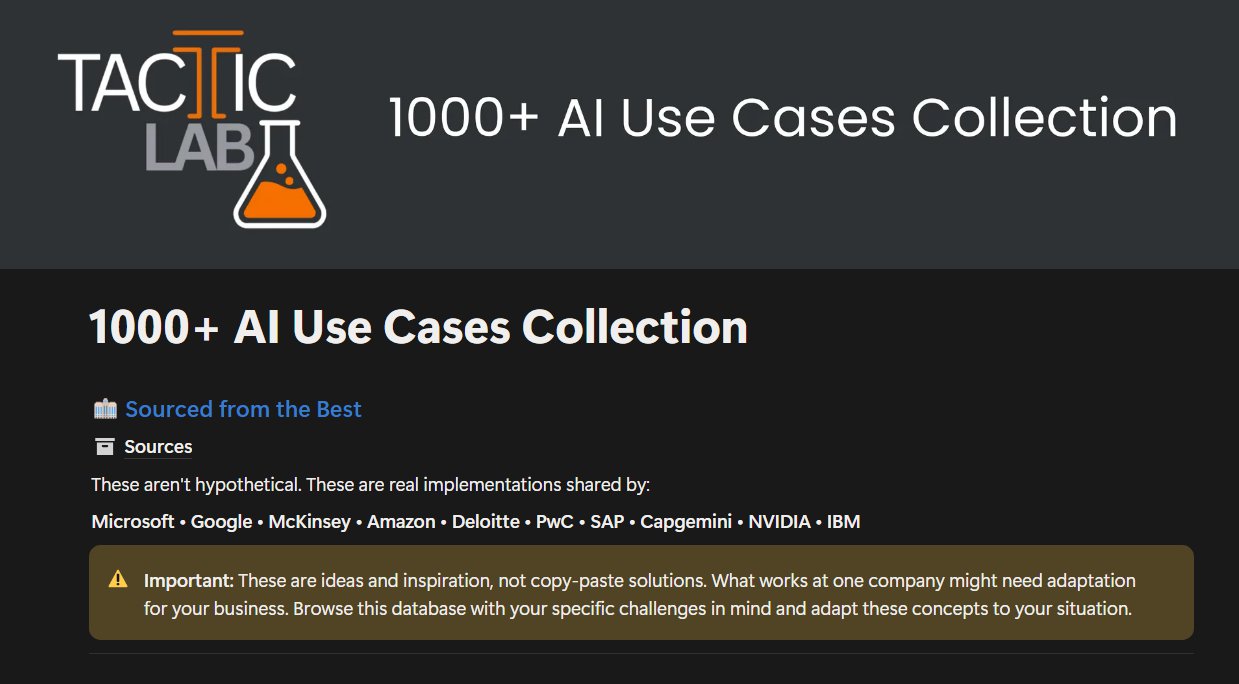
So I did something a bit obsessive about it. I collected over a thousand AI use cases and organized them into one browsable database. And here’s the part that matters: these aren’t hypothetical ideas from a brainstorm. They’re real implementations shared by Microsoft, Google, McKinsey, Amazon, Deloitte, PwC, SAP, Capgemini, NVIDIA, and IBM. Things companies actually shipped.
Why I built it around real implementations
AI idea lists are everywhere, and most of them are the same twenty suggestions reworded. “Summarize meetings. Draft emails.” Fine, but nobody reorganizes their finance function around meeting summaries.
What actually moves people is seeing that a real company, with real auditors and real legacy systems, put AI into their forecasting process or their contract review or their supplier analysis, and hearing what it did for them. Real implementations carry proof that the thing survives contact with corporate reality. That’s why every entry in the collection traces back to a named company’s shared experience.
Read the warning label
There’s a note pinned inside the collection, and I mean it: these are ideas and inspiration, not copy-paste solutions. What works at Amazon works partly because it’s Amazon. Their scale, their data, their engineering bench.
The right way to browse is with your own specific challenges in mind. You’re not shopping for someone else’s solution. You’re looking for the entry that makes you think “wait, we have that exact problem,” and then adapting the concept to your data, your systems, and your constraints. The collection gives you the starting point and the proof it can work. The adaptation is your job, and honestly, it’s the fun part.
How I’d browse it if I were you
Don’t read it like a book. A thousand entries read front to back is a nap. Instead, come in with your three most annoying recurring tasks already written down. The close that drags. The report nobody reads but everyone demands. The data cleanup that eats your Fridays.
Then hunt for entries that touch those. When you find one, ask three questions. Can I verify the output quickly? Does this task repeat every month? Does it hurt enough that the team will actually adopt the fix? A use case that passes all three is worth a pilot. A use case that passes none is trivia, no matter how impressive the company that shipped it.
From someone else’s case to your workflow
One warning from experience: a use case is a direction, not a destination. The gap between “McKinsey does this” and “this runs in my team every month” is process work. Start manual, write down what worked, package the instructions, and only then wire it into your real files. I teach that whole progression in the AI FP&A Accelerator, but the honest first step is cheaper: pick one case from the collection and try it this week on a task you can check.
Get the collection
The download below gets you the full 1000+ AI Use Cases Collection: organized, searchable, sourced from the companies above, with the finance and FP&A cases I care most about well represented. Browse it with your problems in mind, and steal responsibly.
Get the 1000+ AI Use Cases Collection
Organized, searchable, and sourced from real implementations at Microsoft, Google, McKinsey, Amazon and more. Browse it with your problems in mind.