

Sales FP&A: measure the funnel in money and the forecast argument ends
Finance and sales argue about one number: the forecast. Sales says the quarter looks strong. Finance discounts whatever sales says, on principle. Both sides leave the meeting convinced the other one doesn’t get it.
I’ve sat on the finance side of that table for years, and the way out isn’t a better forecast. It’s changing what you look at. Stop staring at the end of the pipeline and start measuring the whole funnel, stage by stage, in money. That’s what my Sales FP&A guide is about, and it hangs on this picture:
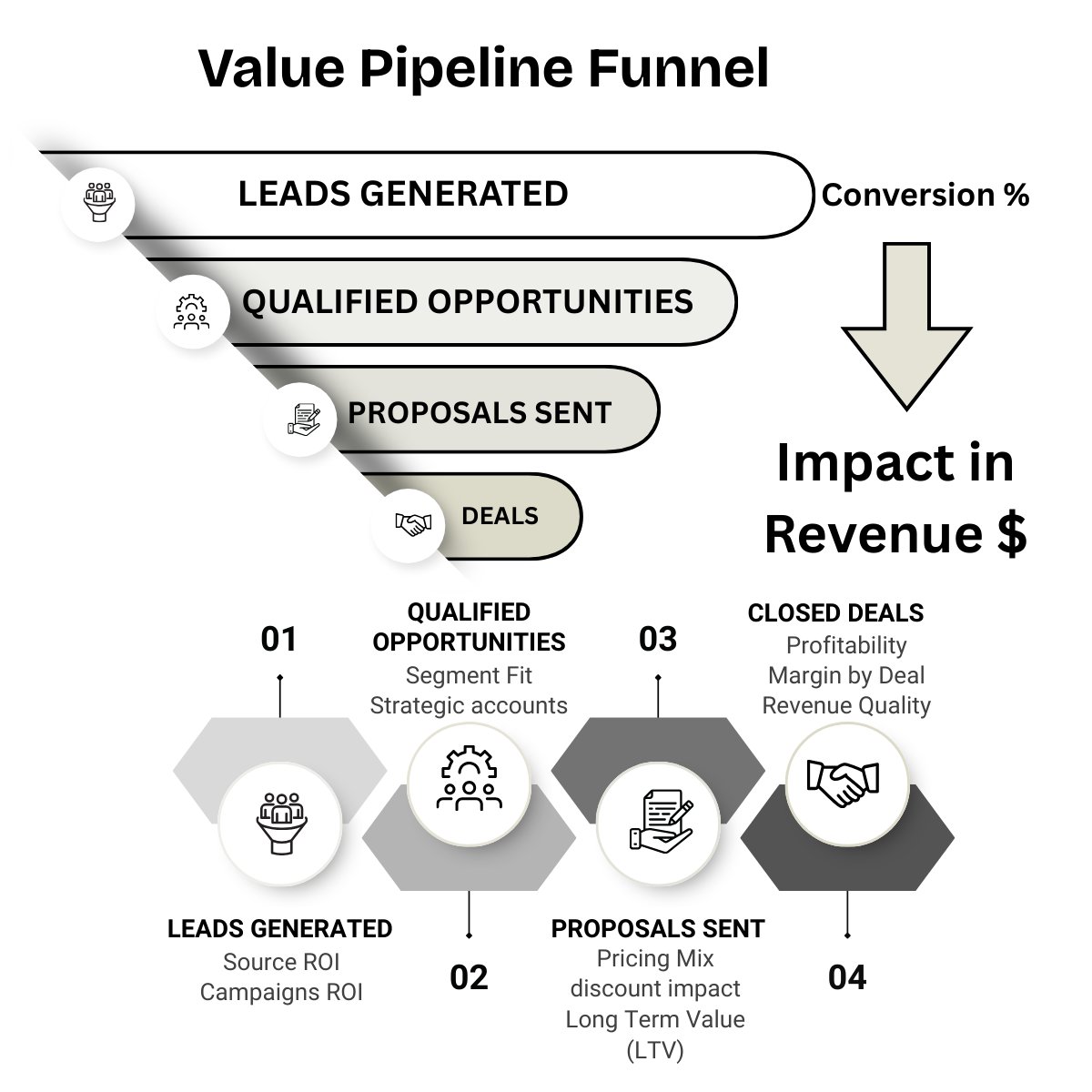
The idea is simple. Every stage of the sales funnel has a conversion rate, and every conversion rate has a dollar value. When finance puts numbers on the whole chain, “how’s the pipeline?” stops being a feeling and becomes a calculation. Here’s what that looks like at each stage.
Stage 1: leads, measured as ROI
At the top of the funnel, the FP&A question isn’t “how many leads?” It’s “what did each source and campaign return?” Marketing spend divided by the revenue that eventually came from it, by channel. The volume number flatters; the ROI number decides. When you can show that one channel produces leads that close at three times the rate of another, next year’s marketing budget basically allocates itself.
Stage 2: qualification, measured as fit
Not all pipeline is created equal, and this is the stage where that gets decided. The finance lens here is segment fit and strategic accounts: are we filling the funnel with customers who look like our best ones, or with whoever answered the phone? A pipeline full of poor-fit deals converts badly and churns fast. Catching that at qualification is worth ten times catching it at renewal.
Stage 3: proposals, where the money leaks
This is my favorite stage, because it’s where finance earns its seat. Three things get decided in a proposal: the pricing mix, the discount, and the long-term value of the deal. Each one has a habit of quietly eroding. Discounts creep as the quarter closes. Pricing mix shifts to whatever’s easiest to sell. LTV gets ignored because it doesn’t hit this quarter.
Track discount impact by rep and by week of the quarter, and you’ll usually find the same pattern: the business buys its forecast in the final two weeks with margin. Somebody should be deciding that on purpose. That somebody is you.
Stage 4: deals, measured by quality
A closed deal isn’t a win yet. It’s a claim on future profitability. The end-of-funnel questions are margin by deal and revenue quality: how much of what we sold actually turns into contribution, and how much of it will still be here next year? Two sales teams can post the same bookings number where one is building an annuity and the other is renting revenue at a discount. Only finance can tell the difference, and only if someone’s measuring.
What this looks like on real data
Theory is nice. Watching it happen is better. I built a synthetic sales CRM database, opportunities, line items, clients, and products with unit costs merged in from the ERP, and recorded myself working it the way a sales business partner actually would.
My favorite moment is the margin hunt. One segment shows 28% gross margin in a month where everything else runs above 50%. Filter down and it’s one proposal. Open the lines and there it is: a product sold at 200 that costs 490. Maybe a mistake, maybe a hook the rep offered to land the deal. Either way, now it’s a conversation with the salesperson before the proposal goes out, not a variance explanation three months after. The same file walks through the payment terms check and the client concentration analysis, the 80/20 view of how much of your revenue sits with how few customers.
What changes when you run it this way
The forecast argument dissolves, mostly. Instead of debating one number, you’re looking at four conversion rates against their own history. If coverage is fine but qualification conversion dropped, that’s a specific, fixable problem with an owner. If discounts spiked, that’s a different conversation with a different owner. The funnel turns one unwinnable argument into four manageable ones.
And something subtler happens: sales starts trusting finance. Not because you got nicer, but because you stopped grading their homework and started helping them see where the machine leaks money. That’s the difference between the FP&A team that gets invited to the pipeline review and the one that reads about it in the CRM afterwards.
Get the guide
The download is the Sales FP&A guide built around this funnel: the four stages, the metrics for each, and how to set up the measurement so it runs monthly without a fire drill. If your forecast meetings feel like negotiations, start here.
Get the Sales FP&A guide
The guide built around the value pipeline funnel: the four stages, the metrics for each, and how to run the measurement monthly without a fire drill.